01 / Silhouette
Boxy
Straight through the body, with little taper from chest to hem. It sits away from the waist instead of following it.
Check: Flat chest width and hem width end up close to each other.
An independent style guide
Visit CAFANSRest-day style studio
Build a relaxed outfit with clear proportions, simple layers and details you can compare before choosing.
oopbuyfindshub.rest is an editorial guide for people researching Oopbuy finds. Explore relaxed outfit ideas and practical fit checks here. Browsing links lead to Cafans, a separate website. This page does not provide Oopbuy account, ordering, shipping or support services.
Illustrative styling images, not live product listings.
Start with the silhouette
Boxy, relaxed and oversized describe a look rather than a size. Read what each one usually means, then check it with numbers — shoulder width, flat chest width and body length — against a garment you already wear.
01 / Silhouette
Straight through the body, with little taper from chest to hem. It sits away from the waist instead of following it.
Check: Flat chest width and hem width end up close to each other.
02 / Silhouette
Roomier than a regular cut but still shaped — the shoulder seam mostly lands where yours does.
Check: Shoulder width sits within a centimetre or two of a shirt that already fits you.
03 / Silhouette
Deliberately wider than the body, usually with a dropped shoulder and a longer or heavier body.
Check: Shoulder-to-shoulder measurement is clearly larger than your own shoulder width.
Boxy, relaxed and oversized are naming conventions used in listings, not one shared sizing standard. Two shops can use the same word for pieces that differ by several centimetres at the shoulder. Treat the label as a starting point and compare shoulder width, flat chest width and body length against a garment you already own.
If you are new to this, the quickest habit is to keep three numbers for one shirt you like and one hoodie you like. Most questions about relaxed fits are answered by comparing against those.
Worked example
Take a short top that ends at the natural waist and pair it with a wide-leg trouser that sits at the hip. The gap between the two hems exposes a horizontal band of the body, and the trouser becomes visually longer. Keep the top the same and swap in a straight leg, and the same waistband position now reads shorter, because there is less cloth to balance the exposed band.
A tee that falls well past the hip covers the waistband and turns the outfit into one long block. The leg line then depends on the trouser width and the shoe. With a straight leg and a low-profile sneaker the outfit reads calm and narrow; with a wider trouser the same length looks heavier. We describe what we see in these proportions — they are styling observations, not rules that suit everyone.
Three ways to dress down
Each case below uses unbranded clothing on purpose, so the proportion is what you are looking at. Every case ends with one concrete thing to compare before choosing.
Case 1
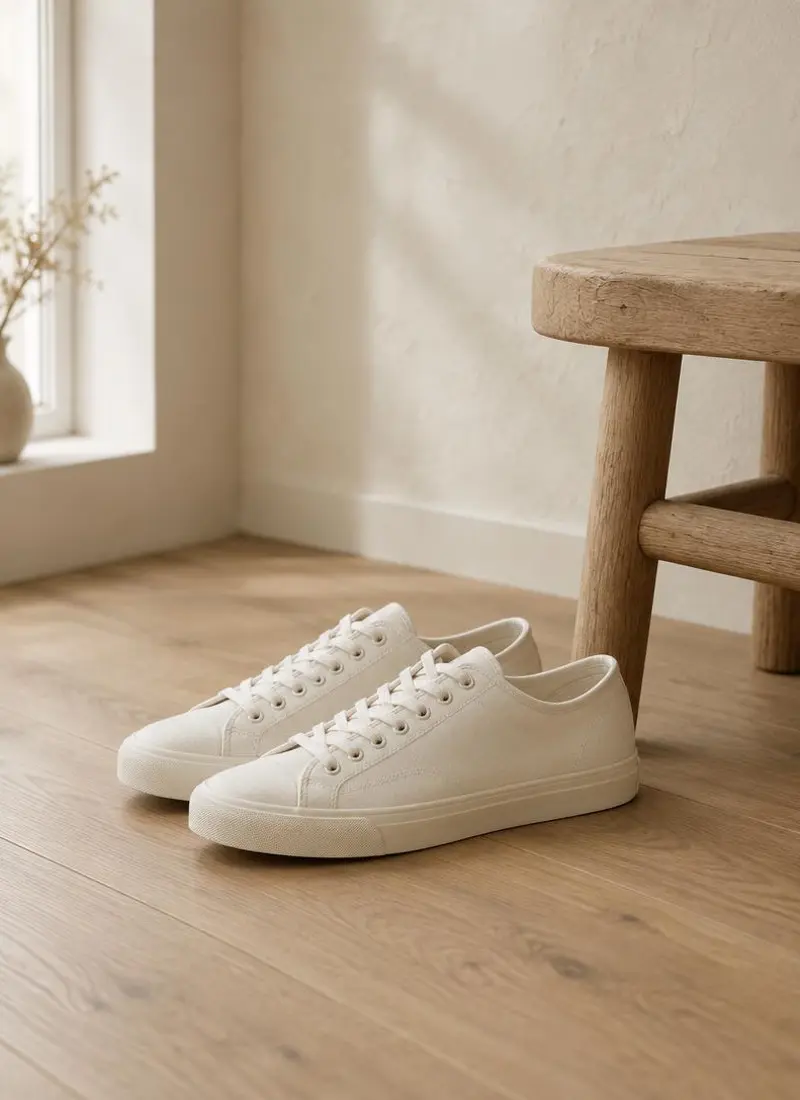
Plain white T-shirt, straight-leg trousers, unbranded white low-top sneakers.
The simplest version of a rest-day outfit, and the one where proportion is most visible. If the tee ends right at the widest part of the hip, the leg line gets cut short; move the hem slightly higher, or push the trousers to a higher rise, and the same outfit suddenly reads longer. A straight leg with a light, matte finish keeps the shape calm next to the plain canvas of the shoe.
How to decide: Decide with one number: tee length. Compare it to a shirt that ends where you like it, then keep the trousers the same and let only the top change.
Case 2
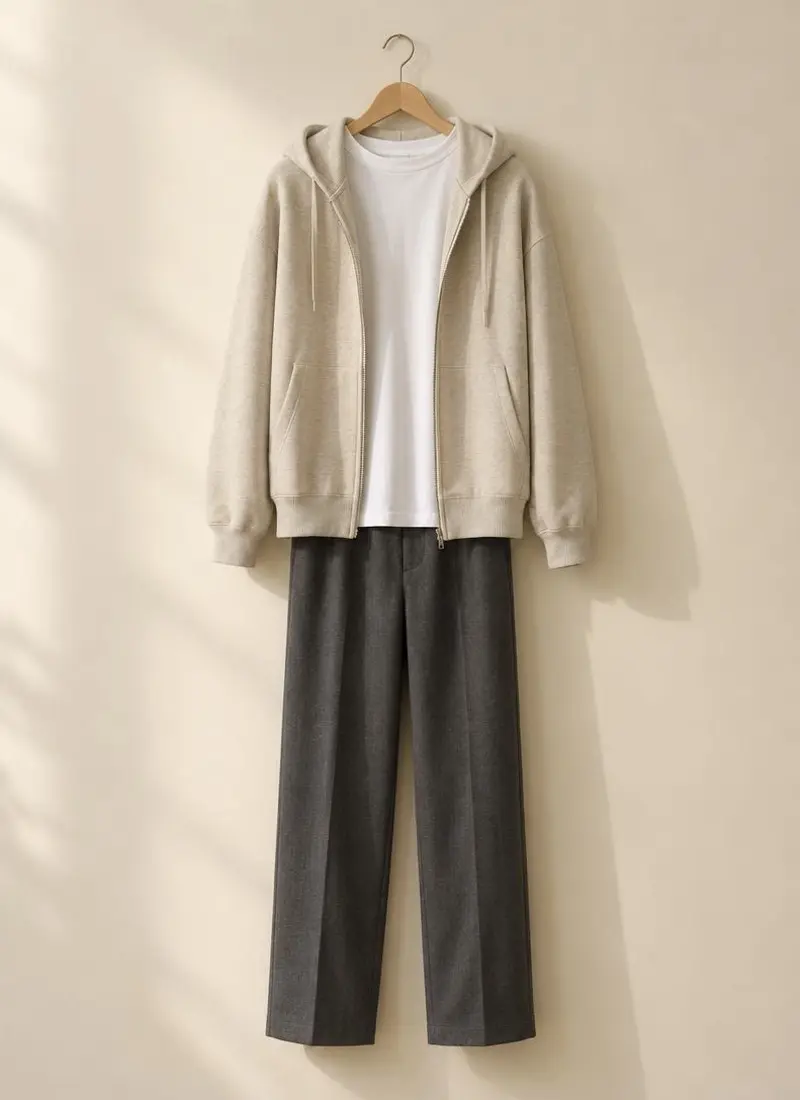
White T-shirt under an oatmeal zip-up hoodie, loose charcoal trousers.
With an open zip, the white tee becomes a narrow vertical strip in the middle of the outfit — which is why this combination looks tidy without effort. The hoodie hem matters more than the sleeve here: it should either sit above the tee hem or clearly below it. Two hems landing within a centimetre of each other create a band across the body that breaks the line.
How to decide: Layer length first, colour second. Check the hoodie hem against the tee by hanging both together, then judge whether the torso still reads as one shape.
Case 3
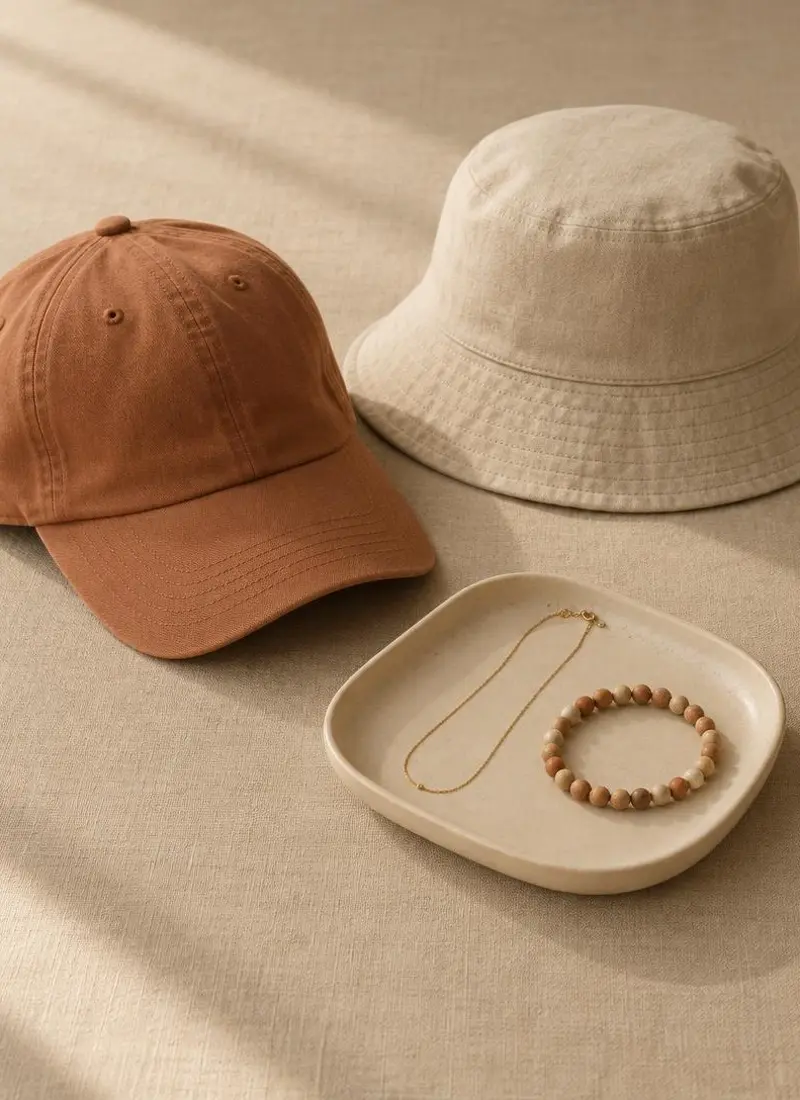
Plain top, casual shorts, plain cap, one thin necklace or bracelet.
The smallest outfit in this guide, and the one where a single detail does all the work. A cap changes the frame around the face; a thin chain adds a line at the chest; a plain bracelet breaks the bare wrist next to the hand. Skip two at once if the top already has an open collar, because three vertical lines at the neck compete.
How to decide: Choose one finishing piece and stop. Check the cap circumference against your head measurement before anything else, since headwear that sits wrong is noticeable at a distance.
Hold a hoodie up against your torso and note where the hem sits relative to your hip bone and the top of your leg. That single position explains most of the difference between two hoodies that share a size label. A zipped front also changes the line, because the open edges draw a vertical stripe down the middle.
For T-shirts, the shoulder seam is the honest measurement. If it sits past your own shoulder, the sleeve starts lower and the whole top reads wider, whatever the chest number says. Compare this before length, especially with a dropped-shoulder cut.
Drape is about weight and cut together. A stiffer cloth holds a straight line away from the leg; a softer one settles closer and shows the knee. When comparing two pairs, read the fabric description next to the inseam and think about how each will hang an hour into wearing them.
Matching sets deserve a separate check. Compare the top half and the bottom half as if they were two different garments, because a coordinated set often uses one loose cut and one closer cut. For two-piece lounge sets in particular, checking each half against a piece you already own tells you more than the size on the label.
Choose the next piece
Start from the base layer, add what you wear over it, then finish. Each category below has one practical check and a clearly labelled link to its CAFANS category page.
Group 1
The pieces that sit closest to the body and set the shape everything else follows. Check these first, because a base layer that is too long or too loose usually decides the fit of the whole outfit.
Start with a side-on photo of the sole: look at how much of the toe the outsole covers and whether the heel sits flat. Then compare your own foot length in centimetres against the shop’s size note, not against a single printed number.
Shoulder width, not the letter size, decides whether a tee reads boxy or relaxed. Measure across the shoulder seam of a shirt you already like, then ask for the same flat measurement on the new one.
Drape changes what a straight-leg silhouette looks like in motion. Compare the fabric description and the inseam together: a heavier cloth falls straighter, a lighter one usually clings after a few hours of wear.
Ask how the waist measurement is defined — lying flat, stretched, or worn on a body — and check the material label. Elastic recovery matters more here than any published size number.
Group 2
Everything you put over the base layer. Here the question is almost always length and how an open front changes the vertical line of the outfit.
A hoodie hem that lands at the hip bone keeps the leg line long; one that stops mid-hip splits the body in two. Compare the hem against a hoodie you already own rather than against a nominal size.
Read the description for lining and closure details before anything else. A jacket with no lining mentioned behaves completely differently over a heavy sweater, so check whether the notes mention one at all.
Matching sets are often cut in one nominal size, but the top and bottom still need separate checks. Compare each measurement against a piece you already own; an oversized top often ships with a regular-cut bottom.
Compare chest width and body length together. A jersey cut wide and short looks layered and sporty, while the same chest width with a longer body reads loose — the second number decides which one you get.
Group 3
Small items that change how a finished outfit reads. These are cheap to compare and easy to get wrong from a photo, so read the written details.
Circumference plus adjustable range is more useful than a one-word size. Note the brim or crown shape as well: a flat brim and a curved brim fit the same head but frame the face differently.
Compare length or circumference, the closure type, and how the material is described. A listing that names the metal or fibre is more informative than one that only says “gold tone” or “leather”.
Category links open CAFANS in this tab. CAFANS is a separate website and is not presented here as an official Oopbuy store. This guide lists no prices, stock levels, ratings or cart functions.
Measure before you choose
Written measurements are more reliable than a photo. Use this table to know what to compare for each item, and what tends to go wrong.
| Item | Measurements to compare | Common mismatch |
|---|---|---|
| Tops — T-shirts, hoodies, jerseys | Shoulder seam to shoulder seam, flat chest width (armpit to armpit, doubled), body length from the high point of the shoulder, and sleeve length from the shoulder seam. Keep body circumference and finished garment width as two different numbers. | A size label chosen from chest circumference alone, on a garment cut boxy or dropped-shoulder. |
| Pants and shorts | Waist measured in the state the shop describes (relaxed or stretched), front rise from crotch seam to waistband, and inseam from crotch to hem. For elastic waists, ask for both the unstretched and stretched number. | Comparing a stretched elastic waist with a fixed waistband, or matching rise on one pair to rise on a very different cut. |
| Shoes | Your foot length in centimetres, foot width at the widest point, and the shop’s own size note or conversion table. A side-on photo of the sole helps show toe shape and heel support. | Assuming a printed size means the same thing across shops. This guide gives no universal size conversion and no fit guarantee. |
| Hats and caps | Head circumference, hat circumference, the adjustable range printed or described by the seller, and the shape of the brim or crown. | Buying on head circumference alone when the crown is shallow, or when the stated adjustment does not cover your measurement. |
| Accessories — necklaces, bracelets, belts | Necklace length and the drop it produces, bracelet circumference or diameter, belt length to the middle hole, closure type, and the unit used (cm or inches). | Mixing centimetres with inches, or comparing a chain length without checking where the clasp sits. |
Example numbers are for demonstration only — always use the seller’s own measurement notes. Fabric composition, lining and care instructions belong in the written details or on the label, and cannot be confirmed from a photo.
The flat-measure method
Take one garment you already wear comfortably — a T-shirt for tops, one pair of trousers, one pair of shoes.
Lay it flat on a table and smooth out the seams without stretching the fabric.
Measure the same points the listing uses, in the same unit, and write the numbers down.
Compare each number on its own rather than an average, then decide which difference you can accept.
Repeat for a second item so you have two reference points instead of one.
A body measurement describes you; a garment measurement describes the cloth. When a listing only gives one of them, don’t convert between the two by guessing a number. Ask which one is measured, or compare the garment number with your own flat-laid clothing instead.
Elastic waistbands have two useful numbers. The relaxed measurement tells you where the trousers sit comfortably; the stretched measurement tells you the limit. Comparing a stretched figure with a fixed waistband is the most frequent mismatch we see in sweatpants and lounge sets.
Foot length alone is an incomplete comparison for low-top sneakers. Note the width at your widest point and look at a side-on sole photograph for toe shape. This guide offers no universal size conversion and makes no fit guarantee, because sizing language differs between shops.
Questions before browsing
Short direct answers first, then the detail behind them. All answers are part of this page.
They take you to CAFANS, a separate website, and open in the same tab.
Every category link in this guide points to a specific CAFANS category page, and the general buttons point to the CAFANS home page. This site is an independent editorial page: it has no Oopbuy account, ordering, shipping or support features, and we do not run the pages you land on.
No. The word describes a look, not a measurement.
An oversized T-shirt might be wide but short, while an oversized hoodie is often wide and long. Instead of trusting the label, compare shoulder width, flat chest width and body length against a garment you already own and like.
Lay a well-fitting garment flat and measure it the same way the listing does.
Use one method: flat chest width is armpit to armpit, body length is from the highest shoulder point down to the hem, and shoulder width runs seam to seam across the back. Note whether the seller measures a body or a garment, since the two differ noticeably.
No. A photo shows appearance, not what a garment is made of.
Fabric content, lining and care instructions should come from the written description or the care label. Photos can hint at texture or sheen, but they cannot confirm fibre percentages, weight or how the material behaves after washing.
Yes. A set sold as one item still has two independent cuts.
Compare the top and the bottom against your own measurements separately. Many sets pair a roomier top with a closer-cut bottom, so a set that fits at the shoulder may sit tight at the waist.
No. The images are styling illustrations created for this guide.
They show unbranded pieces arranged to explain silhouette, layering and proportion. They are not live listings, not stock photography of real inventory, and no jewellery material claims are made from them.
Keep reading
Both guides live on this site, so nothing here sends you away just to read the method. They go deeper on measuring a garment and on how an outfit’s proportions change.
Measurement guide
A five-minute flat-measure routine, a per-item worksheet for tops, trousers, shoes, hats and accessories, and the mismatches worth checking first.
Read the guide
On this site · About 7 minutes
Outfit guide
Three formulas explained through proportion: a hem map, a layering order checklist, three neutral colour pairings and eight plain pieces that keep swapping.
Read the guide
On this site · About 6 minutes